SOFTWARE • DATA ANALYSIS • PREDICTIVE MODELING
Bid Intelligence
An in-development competitive bid analytics platform designed to explore whether historical construction bidding data can be used to model competitor pricing behavior and generate testable pre-bid estimates.
PROJECT OVERVIEW
Turning historical bid results into usable intelligence.
Bid Intelligence began with historical construction bid data containing project estimates, participating contractors, and submitted bid amounts.
I am developing the application to organize that information, analyze historical competitive behavior, and test different approaches for estimating where future competitor bids may fall.
The project is currently an experimental engineering platform, not a production forecasting system. Prediction results are preliminary and are expected to change as the model is refined and additional historical and live bid data becomes available.
APPLICATION INTERFACE
Bid Intelligence dashboard
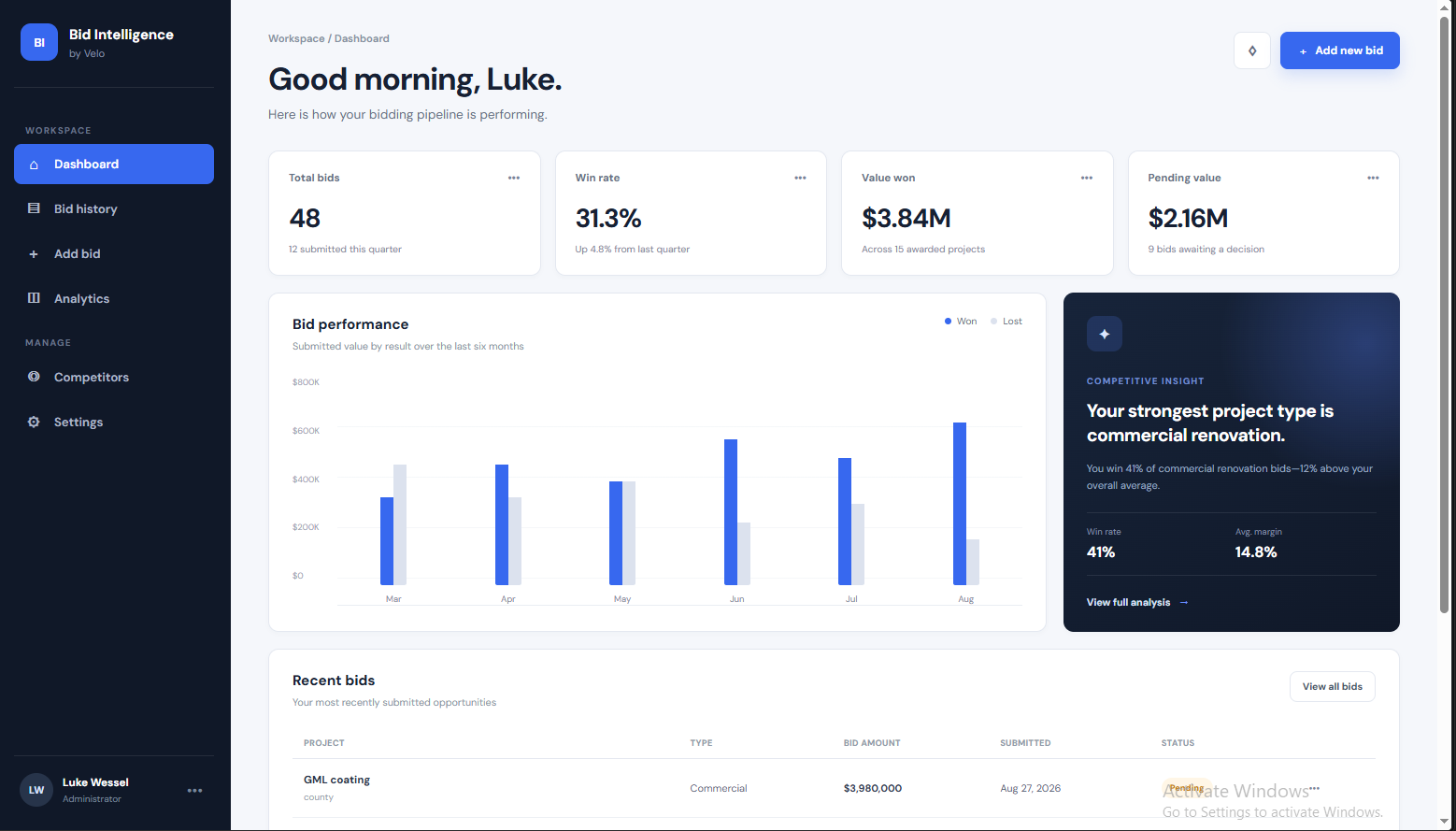
I built the application interface in React to provide a central workspace for historical bids, competitors, analytics, and future prediction workflows.
The dashboard shown below is part of the application prototype. Some dashboard metrics are demonstration data used while the analytical portions of the system are being developed.
ENGINEERING APPROACH
Testing the model without letting it see the future.
One of the main challenges was evaluating prediction ideas without accidentally using information that would not have been available when a historical bid occurred.
I implemented walk-forward backtesting so that a historical project is treated as if its result has not happened yet. The model uses only earlier observations to generate its estimate. The actual result is then revealed and compared against the prediction.
- Historical bid data organization
- Walk-forward backtesting
- Project-size weighting
- Bidder-specific historical weighting
- Competitive-floor modeling
- Model diagnostics
- Live pre-bid prediction workflow
- Real-world prediction validation
- Additional model refinement
- Expanded historical dataset
CURRENT MODEL ITERATION
Model V4 — Competitive-floor backtesting
Model V4 is the current experimental iteration of the prediction engine. It combines historical competitive-floor behavior, project-size weighting, and available contractor-specific history when generating an estimate.
The diagnostic interface exposes the inputs behind each historical prediction, including contractor history, weighting, competitive-floor behavior, the resulting prediction, and the error after the actual result is revealed.
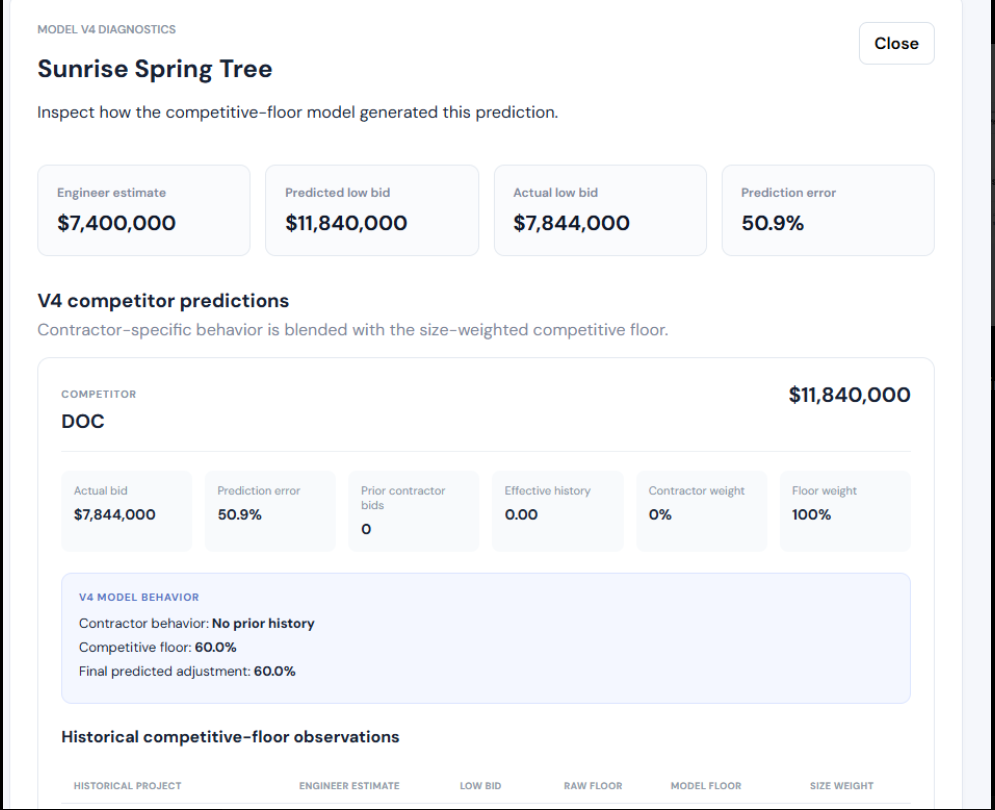
The values shown above are experimental backtesting results, not validated production accuracy. The current historical dataset is limited, and some predictions still produce substantial error.
Rather than hiding those misses, the diagnostics are used to identify where the current model breaks down and what should be improved in the next iteration.
ENGINEERING TAKEAWAYS
What I am learning from the project
Bid Intelligence has required more than building an interface. It has pushed me to think about how data should be structured, how historical tests can accidentally become misleading, and how a model should expose its reasoning and limitations.
The biggest lesson so far has been that improving a prediction model requires measuring where it fails rather than simply producing a prediction. The backtesting and diagnostic tools allow each model iteration to be evaluated before using the same approach on future bid opportunities.
NEXT STEPS
Moving from historical testing to live validation.
The next phase is to record predictions before upcoming bid results are known and compare those saved predictions against the actual results afterward.
As additional bids become available, the historical dataset can grow and provide more evidence for evaluating whether the current modeling approach improves.
Back to portfolio